Live Sports & Events
Which Chinese Streaming Platforms Work in the US?
- Date
- Not recorded
- Broadcast window
- Not recorded
- Platform
- Not recorded
- Region restriction
- No restriction noted
Last verified
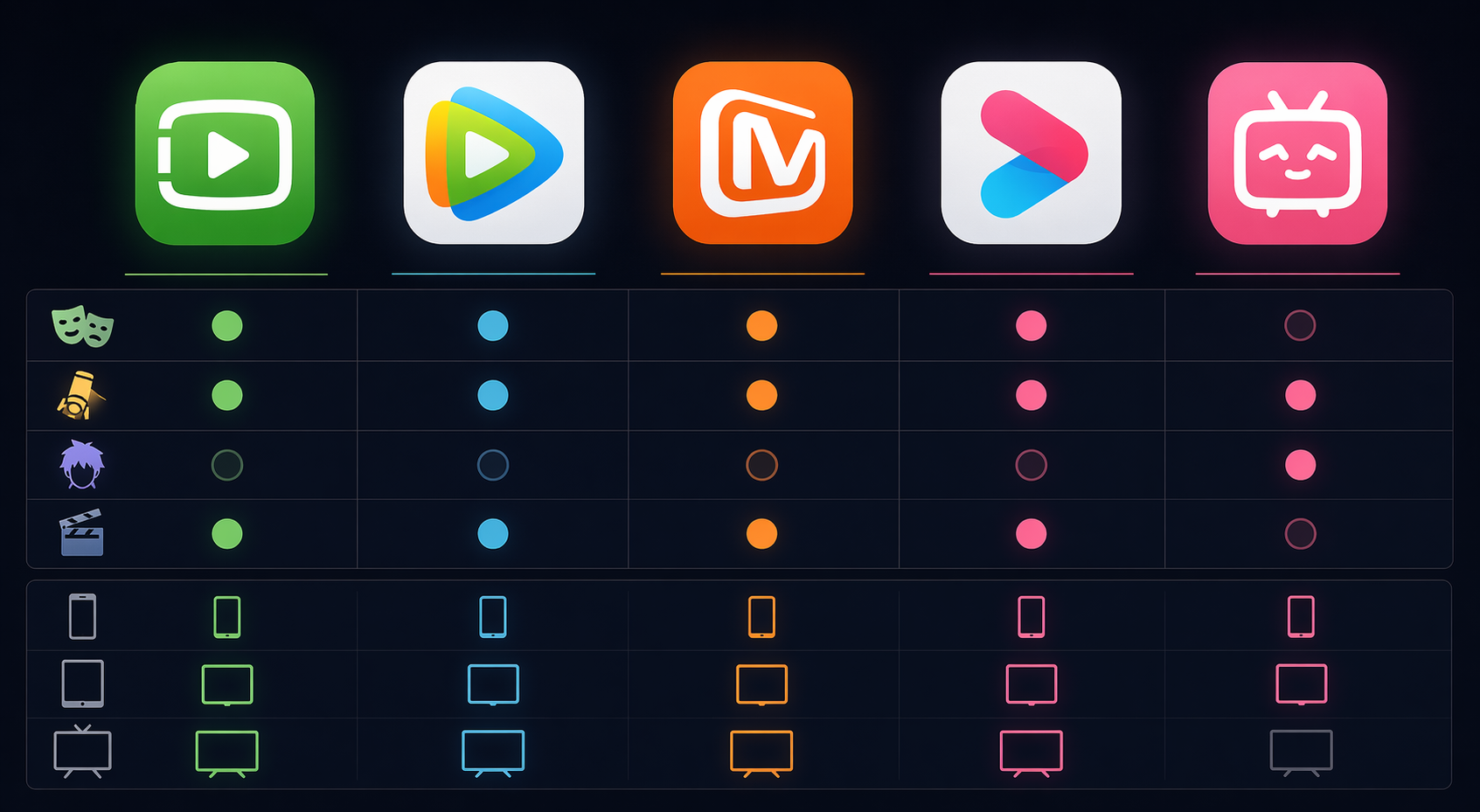
| Platform | US access | Best fit | Free or paid | Known price signals | Confirmed device support | Main friction |
|---|---|---|---|---|---|---|
| iQiyi International | Yes, through the international service | Broadest premium C-drama, Asian drama, movie, and growing microdrama option | Free sampling plus VIP subscription | $1.99/month is promotional; standard monthly pricing is listed at $11.99 | Mobile and web are central; TV support should be checked on your exact device before paying | The international catalog is large, but not the same as the full China-facing iQiyi library |
| WeTV | Yes, through Tencent Video's international app | Chinese dramas plus Tencent originals and localized Asian content from markets such as Thailand and Indonesia | Free ad-supported tier plus paid VIP options | Pricing varies by plan and region inside the app | Mobile and web access are clear; living-room device support is less uniformly documented | Free access is useful, but ads, VIP locks, and regional licensing can shape what you actually watch |
| Mango TV International | Yes, through the international site/app experience | Chinese variety shows, reality programming, and dramas | Positioned around free HD streaming | Free access is the headline; paid features may vary by region or app version | Web and mobile are the safer assumptions | Good low-risk trial, but TV-platform availability should not be assumed |
| Youku International | Yes, through its international app | Chinese drama, variety, and Alibaba-backed platform originals | Free and/or paid access may vary by app region and title | Check current in-app pricing before subscribing | Apple TV and Android TV support are specifically confirmed | More promising for TV viewers than some rivals, but the international catalog can still differ by region |
| Bilibili | Yes, through the international version | Anime, ACG culture, animation-adjacent fandom viewing | Free and paid access can vary by title and region | Check title-level access in the app | Mobile and web are the clearest starting points | The international version is much narrower than China-facing Bilibili |
If you are in the US and trying to decide which Chinese streaming platform to try first, start with the device and the kind of show you actually want tonight. iQiyi is the safest first stop for a broad premium C-drama library. WeTV is the easiest to sample without paying. Mango TV is appealing if variety shows are part of the draw. Youku deserves extra attention if you want a TV-box app, because Apple TV and Android TV support are specifically confirmed. Bilibili is more specialized: useful for anime and ACG fans, but not a substitute for the full China-facing Bilibili experience.
The Short Version: Which Platform Should You Try First?
For most US viewers coming from Netflix, Viki, or YouTube clips, iQiyi International is the most natural first paid test. The international service describes availability across 191 territories, 12 language interfaces, more than 1,700 drama series, and more than 3,500 movies, which gives it the broadest premium-service feel among the platforms in this guide.[1] That does not mean every China-platform title is available in the US, but it does mean the service is not a tiny side catalog.
If you do not want to pay before looking around, start with WeTV or Mango TV. WeTV's international service offers a free ad-supported tier and combines Chinese originals with localized content from other Asian markets, including Indonesia and Thailand.[2] Mango TV International positions itself around free HD streaming of Chinese variety shows and dramas with an English-language interface.[3] Those two are better first clicks for anyone who wants to browse without turning a one-episode curiosity into another monthly subscription.
If your first question is “will this work on my TV?” rather than “which catalog is biggest?”, look at Youku International early. Its confirmed Apple TV and Android TV availability matters because Chinese international apps are not equally clear about Roku, Fire TV, smart TV, and streaming-box support. For a living-room viewer, a slightly smaller catalog on an app that actually opens on the TV can beat a larger one trapped on a phone.
iQiyi International: The Most Developed Premium Starting Point
iQiyi International is the platform I would check first for a US viewer who says, “I liked a C-drama on Netflix and want more of that.” Its biggest advantage is not just the size of the catalog; it is the combination of dramas, movies, language support, international packaging, and a VIP model that feels closer to familiar subscription services than some of the more fragmented Asian-platform apps.
The service says it reaches users across 191 territories and supports 12 language interfaces, with a catalog that includes more than 1,700 drama series and more than 3,500 movies.[1] For a US viewer, those numbers are useful as scale signals, not as a guarantee that every title you have seen mentioned on Chinese social platforms will appear in the US app. International rights, subtitle availability, and regional windows still matter.
The price needs careful reading. The $1.99/month figure attached to iQiyi is promotional, while the standard monthly price cited in the available materials is $11.99.[1] That promotional number can be a good reason to test the service, but it should not be treated as the normal long-term cost unless the checkout screen says so at the time you subscribe.
iQiyi also matters because it is pushing beyond conventional long-form drama. ContentAsia reported a 130% year-on-year global viewership surge for iQiyi in the first half of 2026, driven by a dual strategy of long-form premium titles and microdramas, with self-produced Chinese dramas dominating its global top 10.[4] That is a platform-direction fact, not proof that every individual show is better there, but it helps explain why the international service feels more actively built out than a simple export shelf.
WeTV: The Free Tier Makes It Easy to Test
WeTV is Tencent Video's international route, and its free ad-supported access is the main reason US viewers should not skip it. A free tier changes the trial math: you can check subtitles, playback, casting behavior, and whether the shows you care about are actually unlocked before deciding whether VIP access is worth it.
The service is not only a Chinese-drama pipe. WeTV presents original Chinese content alongside localized content from Asian markets such as Indonesia and Thailand.[2] That makes it a better fit for viewers who want a broader Asian entertainment mix rather than a platform devoted only to mainland Chinese series.
The tradeoff is that “free” does not mean frictionless. Expect ads, title-level locks, VIP prompts, and regional differences. The practical move is to search for the exact show first, open an episode, and confirm whether the subtitles and playback quality work for you before comparing paid plans.
Mango TV International: Best for Variety-Curious Viewers Who Want a Low-Risk Start
Mango TV International is the one I would put in front of a viewer who asks for Chinese variety shows, reality formats, celebrity-driven programming, and a free way to browse. Its international site presents free HD streaming of Chinese variety shows and dramas and includes an English-language interface.[3]
That free positioning is useful because variety libraries can be harder to evaluate from the outside than scripted drama libraries. With dramas, a viewer often arrives with a title or actor in mind. With variety, the question is more often whether the format, subtitles, pacing, and guest mix click at all. Mango TV lets you answer more of that before making a payment decision.
The caution is device support. Web and mobile access are the safer assumptions from the available material. If your plan is to watch long variety episodes on a couch, confirm your exact TV setup before treating Mango as your main living-room app.
Youku International: Pay Attention if You Watch on Apple TV or Android TV
Youku International is the platform where device wording matters most. It has a dedicated international app available on US app stores, and Apple TV and Android TV support are specifically confirmed in the available platform information. That makes it a serious option for viewers who do not want to build a viewing routine around phone mirroring or browser workarounds.
Content-wise, Youku belongs in the same conversation as the other major Chinese video platforms: drama, variety, and platform originals are the draw. The question for a US viewer is less whether Youku is a major Chinese platform and more whether the international version carries the specific titles you want with English subtitles and a device path you can live with.
Bilibili: Useful, but Do Not Expect the Full China Platform
Bilibili is the easiest platform here to misunderstand. For anime, ACG culture, animation-adjacent viewing, and fandom discovery, the international version can be worth installing. But it is not equivalent to the full China-facing Bilibili catalog, and that distinction should shape expectations from the start.
That narrower library does not make Bilibili irrelevant. It just makes it a specialist pick rather than the first answer for someone who wants mainstream C-drama depth. If your watchlist is anime-heavy, check Bilibili. If your watchlist is historical romance, modern urban drama, or long-form Chinese variety, start elsewhere.
Device Support Is Where the Fine Print Starts
Chinese streaming platforms are much easier to reach in the US than they used to be, but “available internationally” and “easy on every living-room device” are different claims. Mobile apps and web playback are usually the cleanest entry points. TV apps are where the documentation gets uneven.
| Device question | What to do before paying |
|---|---|
| Do you watch mostly on iPhone, iPad, or Android? | Install the app, search your top two titles, and test subtitles and playback before subscribing. |
| Do you watch mostly on Apple TV? | Check Youku first because Apple TV support is specifically confirmed; verify the others in the App Store on the device itself. |
| Do you watch mostly on Android TV or Google TV? | Check Youku first because Android TV support is specifically confirmed; search each rival app on the actual TV device. |
| Do you use Roku or Fire TV? | Do not assume support. Confirm app availability directly on the device store before buying a VIP plan. |
| Do you plan to cast from a phone? | Test casting with a free episode before paying; casting support can be less reliable than native TV apps. |
The safest subscription sequence is boring but effective: install first, search second, play third, subscribe last. A platform can have the right catalog and still be the wrong choice if it forces you into a device routine you hate.
Pricing: Cheap Can Still Be Confusing
The appeal is obvious: compared with many US streaming subscriptions, Chinese international platforms can look extremely inexpensive. The problem is that low entry prices, promotional plans, VIP locks, and regional plan differences can get blended together in casual recommendations.
iQiyi is the clearest example. The $1.99/month number is promotional, while the standard monthly price cited in the available material is $11.99.[1] Those are very different subscription decisions. One is a low-cost trial; the other belongs in the same monthly-budget conversation as other paid streamers.
For WeTV and Mango TV, the free-access story is real enough to make them good first tests, but free tiers are not the same as full access. Some titles may be ad-supported, some may require VIP, and some may shift by region or window. Treat the checkout screen and the title page as more authoritative than any old pricing screenshot.
How to Choose by What You Actually Watch
- Cheapest first test: WeTV or Mango TV, because both give you meaningful ways to browse before committing to a paid plan.
- Biggest premium C-drama starting point: iQiyi International, because its international service has the strongest scale and catalog signals among the options covered here.
- Variety shows and reality programming: Mango TV International, especially if you want to sample Chinese variety without starting with a paid subscription.
- Anime and ACG: Bilibili, with the important warning that the international library is narrower than the China-facing platform.
- TV-device convenience: Youku International, especially for Apple TV and Android TV users.
- Lowest tolerance for app friction: Start with the platform that works cleanly on your device, not the one with the biggest claimed catalog.
Why These Platforms Are No Longer Niche Side Apps
The practical subscription question comes first, but the scale is worth understanding. A Wikipedia table aggregating recent earnings-report figures lists Tencent Video at 120 million subscribers, iQiyi at 101.4 million, Youku at 90 million, Mango TV at 73.3 million, and Bilibili at 28.5 million; together, that puts the five above 400 million subscribers globally, compared with Netflix's listed 325 million.[5] Those figures come from 2024–2025 reporting windows, so they should be treated as scale context rather than exact Q3 2026 counts.
That scale helps explain why these apps increasingly feel like primary services rather than obscure imports. They are not simply waiting for Netflix, Viki, or another US-facing service to license a small slice of Chinese entertainment. They are building direct international routes, with their own apps, interfaces, subscription funnels, and overseas programming strategies.
Microdramas are part of that push. DW reported, citing Media Partners Asia, that the short-drama market outside China was worth $1.4 billion globally in 2024 and was projected to reach $9 billion by 2030; because that projection is cited secondhand, it is best read as a directional market estimate rather than a figure independently verified here.[6] The same report described COL Group building a dedicated microdrama studio near Macau with a 10,000-square-meter facility and 30 international production teams.[6]
iQiyi is moving in the same direction. Seeking Alpha's coverage of the company's plans says iQiyi intends to launch more than 100 short-form dramas in 2026 and that overseas membership revenue is growing by more than 40% year over year.[7] That does not mean microdramas replace long-form C-dramas for US viewers, but it does mean the international apps are likely to keep feeling more active and more crowded.
What About Netflix, Viki, and YouTube?
Netflix and Viki still matter for US viewers because they reduce friction. If a C-drama is already on a service you use, with reliable subtitles and a polished TV app, that may be the easiest way to watch it. Netflix has also expanded its C-drama exposure, and iQiyi's “Pursuit of Jade” became available on Netflix in select regions, which shows how Chinese platform originals can travel through familiar global services.[8]
YouTube is the no-subscription fallback worth checking before you pay. iQiyi, Mango TV, and Tencent Video maintain official YouTube channels with full episodes and English subtitles. YouTube will not replace the full platform experience, and availability can be partial or promotional, but it is useful for sampling a show, checking subtitle style, or watching a title that has been officially posted.
The reason to install the Chinese platforms directly is depth and timing. If you want a broader pipeline of C-dramas, Chinese variety, Asian regional originals, anime-adjacent content, or short-form drama experiments, the direct apps get you closer to the ecosystem. The right pick depends less on which company sounds biggest and more on the smaller details: whether your title is there, whether English subtitles are there, whether the app works on your device, and whether the price you see is a promotion or the standard monthly cost.
References
- iQIYI About Us, iQ.com
- WeTV, WeTV
- Mango TV International, Mango TV
- ContentAsia article, ContentAsia
- List of streaming media services, Wikipedia
- DW article, DW
- Seeking Alpha article, Seeking Alpha
- Daily Chinese Stories article, Daily Chinese Stories